

Supplier: Hebei Weitong FRP Co.,Ltd
Address: No.101 Chunfeng Street, Jizhou District, Hengshui City, Hebei Province
Country: China
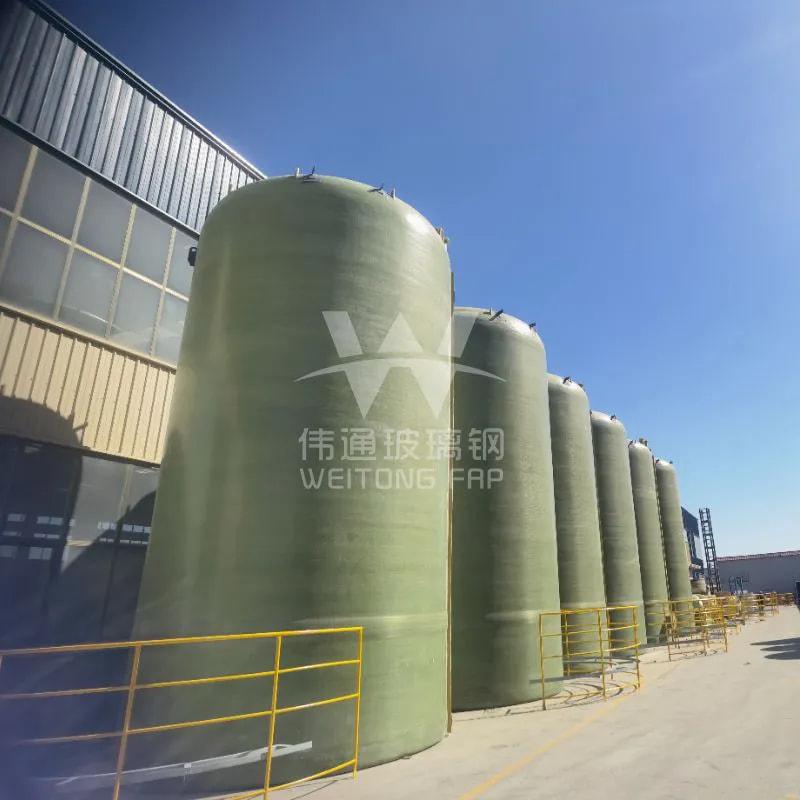
Fiberglass Vertical Storage Tank
Price:
Fiberglass Vertical Storage Tank
A fiberglass vertical storage tank is an upright cylindrical container primarily used to store liquid media under atmospheric or micro-pressure.
Core Features
Vertical Structure
Saves floor space.
Large Capacity
Volumes range from a few cubic meters to hundreds of cubic meters, or even thousands of cubic meters.
Non-Pressure (Main Body)
Primarily withstands the static pressure of the liquid, not the high pressure generated by the process system. The top is typically vented to the atmosphere or has only a breather valve.
Key Advantages
1. Excellent Corrosion Resistance (Core Advantage)
Customized resin systems (such as epoxy, unsaturated polyester, and vinyl ester resins) can be customized based on the chemical properties of the storage medium (acids, bases, salts, organic solvents, etc.) to achieve the most economical and long-lasting corrosion protection.
2. Lightweight and High Strength
Weighing only 1/4 to 1/5 that of carbon steel, it is easy to transport and install. At the same time, its high specific strength allows it to withstand the static pressure of the medium and certain external loads.
3. Long Service Life
Under suitable application conditions, the designed service life can exceed 20 years, with extremely low maintenance costs.
4. Flexible design and easy molding.
Accessories such as mixing stations, level gauges, ladders, and platforms can be easily added. Extra-large tanks can be created on-site by winding.
5. Smooth interior, less prone to scaling.
The smooth interior surface facilitates cleaning and draining, and reduces fluid resistance.
Structural Components:
A typical FRP vertical tank typically consists of the following components:
1. Liner
This is the key layer for corrosion and leakage prevention. It typically consists of a resin-rich layer and chopped fiber mat, with a resin content exceeding 90%, forming a dense barrier.
2. Structural Layer
Also known as the strength layer, this layer is wound with continuous glass fiber and provides the tank's primary mechanical strength to withstand hydraulic, wind, snow, and seismic loads. Its thickness is determined by calculation.
3. Outer Protective Layer
This layer is rich in resin and contains UV absorbers to protect the structural layer from atmospheric aging, particularly sunlight, wind, and rain.
4. Accessories
5. Tank Roof: Typically domed (conical or spherical) with vents and manholes.
6. Tank Bottom: Flat or slightly tapered for easy emptying.
7. Ports: Inlet, outlet, overflow, drain, manhole, sight glass, level gauge port, etc.
8. External Structure: Ladder, platform (for large tanks).
Main Application Areas
1. Chemical Industry: Storage of corrosive chemicals such as various acids, alkalis, saline solutions, and organic intermediates.
2. Environmental Water Treatment:
Wastewater Treatment: Equalization tanks, neutralization tanks, aeration tanks, and sludge storage tanks.
Pure Water/Ultrapure Water: Pure water tanks and reverse osmosis tanks.
3. Metallurgy and Power Industry: Desulfurization tower slurry tanks, circulating water treatment tanks, and pickling liquid storage tanks.
4. Food Brewing: Storage of soy sauce, vinegar, alcohol, and fruit juice. 5. Papermaking Industry: Storage of pulp and various chemical solutions.
Standards and Specifications
Chinese Standard: JC/T 587-1995 "Glass Fiber Wound Reinforced Plastic Storage Tanks"
International Standards:
ASTM D3299: Standard Specification for Glass Fiber Wound Polyester Resin Chemical Storage Tanks (Atmospheric Pressure).
BS 4994: British Code for the Design and Construction of Reinforced Plastic Containers and Tanks.
ASME RTP-1: Specification for Reinforced Thermosetting Plastic Equipment, a highly authoritative and stringent design and construction standard.
Learn about the latest products in the https://www.frpwt.com/products/
A fiberglass vertical storage tank is an upright cylindrical container primarily used to store liquid media under atmospheric or micro-pressure.
Core Features
Vertical Structure
Saves floor space.
Large Capacity
Volumes range from a few cubic meters to hundreds of cubic meters, or even thousands of cubic meters.
Non-Pressure (Main Body)
Primarily withstands the static pressure of the liquid, not the high pressure generated by the process system. The top is typically vented to the atmosphere or has only a breather valve.
Key Advantages
1. Excellent Corrosion Resistance (Core Advantage)
Customized resin systems (such as epoxy, unsaturated polyester, and vinyl ester resins) can be customized based on the chemical properties of the storage medium (acids, bases, salts, organic solvents, etc.) to achieve the most economical and long-lasting corrosion protection.
2. Lightweight and High Strength
Weighing only 1/4 to 1/5 that of carbon steel, it is easy to transport and install. At the same time, its high specific strength allows it to withstand the static pressure of the medium and certain external loads.
3. Long Service Life
Under suitable application conditions, the designed service life can exceed 20 years, with extremely low maintenance costs.
4. Flexible design and easy molding.
Accessories such as mixing stations, level gauges, ladders, and platforms can be easily added. Extra-large tanks can be created on-site by winding.
5. Smooth interior, less prone to scaling.
The smooth interior surface facilitates cleaning and draining, and reduces fluid resistance.
Structural Components:
A typical FRP vertical tank typically consists of the following components:
1. Liner
This is the key layer for corrosion and leakage prevention. It typically consists of a resin-rich layer and chopped fiber mat, with a resin content exceeding 90%, forming a dense barrier.
2. Structural Layer
Also known as the strength layer, this layer is wound with continuous glass fiber and provides the tank's primary mechanical strength to withstand hydraulic, wind, snow, and seismic loads. Its thickness is determined by calculation.
3. Outer Protective Layer
This layer is rich in resin and contains UV absorbers to protect the structural layer from atmospheric aging, particularly sunlight, wind, and rain.
4. Accessories
5. Tank Roof: Typically domed (conical or spherical) with vents and manholes.
6. Tank Bottom: Flat or slightly tapered for easy emptying.
7. Ports: Inlet, outlet, overflow, drain, manhole, sight glass, level gauge port, etc.
8. External Structure: Ladder, platform (for large tanks).
Main Application Areas
1. Chemical Industry: Storage of corrosive chemicals such as various acids, alkalis, saline solutions, and organic intermediates.
2. Environmental Water Treatment:
Wastewater Treatment: Equalization tanks, neutralization tanks, aeration tanks, and sludge storage tanks.
Pure Water/Ultrapure Water: Pure water tanks and reverse osmosis tanks.
3. Metallurgy and Power Industry: Desulfurization tower slurry tanks, circulating water treatment tanks, and pickling liquid storage tanks.
4. Food Brewing: Storage of soy sauce, vinegar, alcohol, and fruit juice. 5. Papermaking Industry: Storage of pulp and various chemical solutions.
Standards and Specifications
Chinese Standard: JC/T 587-1995 "Glass Fiber Wound Reinforced Plastic Storage Tanks"
International Standards:
ASTM D3299: Standard Specification for Glass Fiber Wound Polyester Resin Chemical Storage Tanks (Atmospheric Pressure).
BS 4994: British Code for the Design and Construction of Reinforced Plastic Containers and Tanks.
ASME RTP-1: Specification for Reinforced Thermosetting Plastic Equipment, a highly authoritative and stringent design and construction standard.
Learn about the latest products in the https://www.frpwt.com/products/


CATEGORY
 Agriculture