

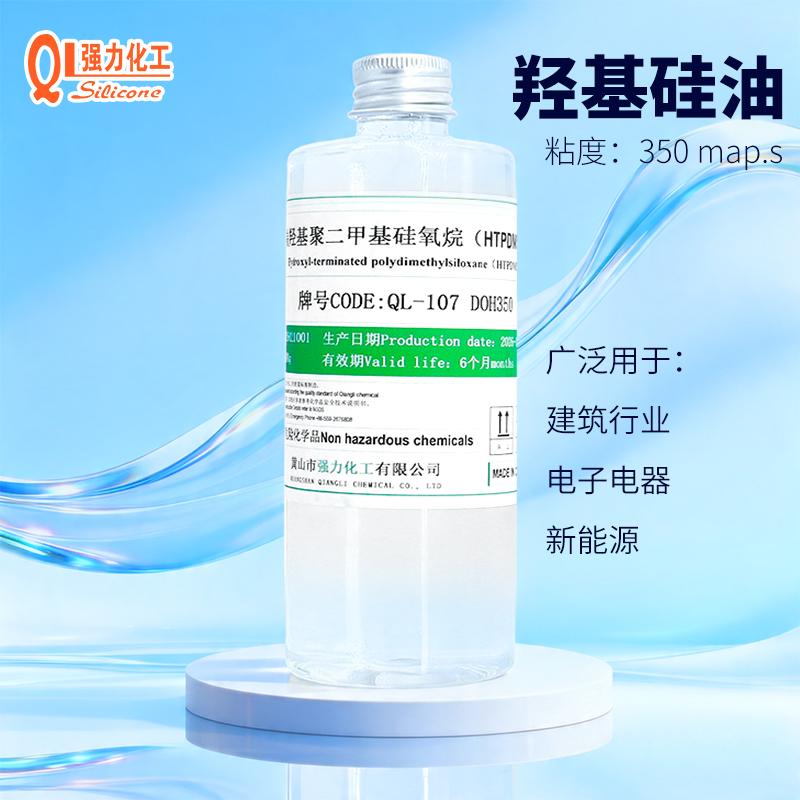
Supplier: Huangshan Qiangli Chemical Co., Ltd.
Address: No. 23, Weiyi Road Circular Economy Industrial Park Shexian County Huangshan City Anhui Province
Country: China
107 Adhesive, Hydroxy Silicone Oil 350 Viscosity
Price: Negotiable
Hydroxyl-terminated silicone oil, also known as dimethyl hydroxyl-terminated silicone oil, has the structural formula HO[(CH₃)₂SiO]nH. It is a linear polymer with a repeating siloxane bond as the main chain, methyl groups as side chains, and hydroxyl groups at the ends. This silicone oil is colorless, transparent, odorless, and tasteless. It is soluble in organic solvents such as carbon tetrachloride, benzene, chloroform, diethyl ether, and toluene, but insoluble in water and ethanol; low-viscosity hydroxyl silicone oil exhibits some solubility in water. It can be used to manufacture silicone hydroxyl emulsions and serves as a treatment agent for textiles, paper, and leather. Dimethyl hydroxyl silicone oil is widely used as a structure control agent in silicone rubber processing. It effectively controls the cross-linking reaction between the compound and silica, improves the processing properties of silicone rubber, and extends the shelf life of the compound. Dimethyl hydroxyl silicone oil can also be used as an intermediate in the synthesis of various polysiloxanes.
Chemical Properties
It not only possesses properties similar to those of dimethylsiloxane (such as methyl silicone oil) but also exhibits unique properties resulting from its active silyl-terminated groups. Under the action of acidic or basic media, it can undergo condensation reactions with organoalkoxy silanes, organoacyloxy silanes, and amino silanes to form high-molecular-weight polymers; it also reacts with boronates, titanates, silicates, and silyl hydrides to form cross-linked products.
Hydroxyl-terminated silicone oil can be reacted with amino-alkyl silanes (such as coupling agent KH-550 or coupling agent KH-602) to synthesize amino-terminated silicone oil. The reaction product is an amino-terminated silicone oil with increased molecular weight, in which the amino-alkyl groups are grafted onto the side chains of the polysiloxane backbone. The ratio of reactants is determined by the amine value of the amino silicone oil to be produced. For example, when using KH-602, a product with an amine value of 0.3 requires 96.67% hydroxyl-terminated silicone oil and 3.33% KH-602. The reaction proceeds under alkaline conditions; adding sodium hydroxide tablets equivalent to one ten-thousandth of the total feed weight to the reaction mixture significantly accelerates the reaction. The average molecular weight of the product is estimated by measuring viscosity through sampling. The reaction has a low activation energy and proceeds under mild conditions at temperatures >80°C. Under vacuum conditions, the reaction byproducts—methanol and water—must be removed from the system. When reacting at atmospheric pressure, the reaction time must be extended, and the reaction temperature raised to approximately 105°C. If water is not adequately removed during the reaction, it may result in high product viscosity and turbidity, though this does not affect performance. Chain terminators with inert end-capping groups, such as hexamethyldisilane, can be added during polymerization to control product viscosity; however, this causes the product to lose hydroxyl groups, thereby reducing its cross-linking and film-forming properties.
Adding a small amount of hydrogen-containing silicone oil (HMPS) to a hydroxyl silicone oil emulsion, under the action of metal catalysts such as organotin or organozirconium, allows the two to cross-link and form a network structure.
Hydroxyl silicone oil can react with polyurethane to synthesize polysiloxane polyurethane. Prior to this reaction, the hydroxyl-terminated silicone oil must be pretreated to remove water in order to minimize side reactions. Under actual reaction conditions, a polyisocyanate curing agent and dibutyltin bis(2-methoxysiloxy) silicate catalyst are first mixed, then the mixture is purged with nitrogen. The hydroxyl-terminated silicone oil is added dropwise under conditions maintained at 70°C to initiate the reaction. During the reaction, the progress is monitored by measuring the content of -NCO groups. When the content falls below half of the amount added, the mixture is cooled and discharged, then stored away from light.
The reaction between hydroxyl-terminated silicone oil and triethanolamine to form amine-modified silicone oil under the action of a catalyst is a polycondensation reaction between polymers. It is relatively easy to carry out and can occur at relatively low temperatures. Acids with good dehydrating properties are used as catalysts for the reaction, with phosphoric acid > sulfuric acid > hydrochloric acid in terms of catalytic effectiveness. Benzene is used as the reaction solvent; the temperature must be higher than the solvent’s boiling point to facilitate separation, but it must not be too high, otherwise the reaction system is prone to oxidation and the color will darken. The reaction product is a mixture, and the endpoint of the reaction varies depending on the reaction temperature and duration.
Some acids containing hydroxyl groups can react directly with hydroxyl-containing silicone oils to polymerize and form cross-linked polymer solids. For example, boric acid can be used to produce silicone products after reacting for approximately two hours in a high-temperature vacuum kneader. This material exhibits a unique shear-thickening effect because the electron-deficient orbitals of boron acquire lone pair electrons from the oxygen atoms on adjacent molecular chains, leading to the formation of weak physical cross-links between boron and oxygen. These transient electronic bridges form between molecular chains, causing them to cross-link into a cross-linked structure. Moreover, this cross-linked structure is reversible. When force is applied for a sufficiently long duration—i.e., at low shear rates—these transient cross-links break, allowing the molecular chains to slip past one another, resulting in a low-viscosity liquid. Under high shear rates, cross-link relaxation occurs; molecular chains cannot move through the cross-links, causing a large accumulation of chains at these points and creating significant resistance, which manifests as a substantial increase in viscosity, similar to a swelling fluid. The reaction products are a mixture, and the final products depend on the reaction conditions and the ratio of raw materials.
Applications
Low-molecular-weight hydroxyl-terminated silicone oils are commonly used in the preparation of block copolymers and defoamers. Widely used in the silicone rubber products industry, it serves as an excellent structural control agent for silicone rubber processing. It improves processing performance, extends the shelf life of the compound, enhances the transparency of rubber products, and improves the mechanical properties of silicone rubber. It is also used to prepare cationic, anionic, and nonionic hydroxy silicone oil emulsions (hydroxy emulsions), and when used in combination with hydrogen-containing silicone oils, it serves as an excellent treatment agent for textiles, leather, and paper.
Hydroxyl Silicone Oil Emulsion
High-molecular-weight hydroxyl silicone oil is primarily used in the base compounds of room-temperature vulcanizing (RTV) silicone rubber. The resulting silicone rubber products exhibit resistance to high and low temperatures, oxidation resistance, and excellent electrical insulation properties. They are widely used in electronics, electrical appliances, cutting-edge defense technology, and other industrial sectors.
Silicone Rubber
Low-molecular-weight dimethyl hydroxyl silicone oil has excellent anti-structuring properties and can be used as a silicone rubber structuring agent (wetting agent). Structuring agents are primarily used to improve the affinity between silicone rubber particles and fillers; this property directly influences the reduction in plasticity during the storage of compounded silicone rubber prior to vulcanization. For example, when compounding silicone rubber, the addition of hydroxyl silicone oil reacts with the Si-OH groups on silica to make it hydrophobic. This aids in the uniform dispersion of silica in the green compound and prevents the compounding silicone rubber from cross-linking, thereby reducing re-compounding time, gel formation, compound viscosity torque, post-vulcanization hardness, and permanent deformation. However, properties such as tensile strength reach a maximum value during the treatment process; therefore, there is an optimal range between the degree of treatment and strength.
Plasticizers
When dimethyl hydroxyl silicone oil is blended with dimethyl hydrosiloxane to form a silicone emulsion used in fabric finishing, a reaction occurs to form a silicone film that coats the fabric surface. This extremely thin silicone film has good adhesion strength, giving the treated fabric a soft yet firm texture and providing water-repellent properties. To achieve optimal finishing results, it is generally necessary to convert the thermodynamically stable helical structure of hydroxyl silicone oil into a linear, extended chain structure at temperatures above 140°C. This allows the silicone to spread across the fiber surface as a monolayer. Suitable conditions involve drying at 90°C followed by a short-term bake at 140°C. After baking, the hydroxyl-functionalized silicone oil forms an elastic film on the fabric surface. This film is insoluble in alkaline solutions and exhibits excellent wash resistance.
The principle behind hydroxy silicone oil finishing is that fabrics made from natural materials are woven from warp and weft yarns, which are composed of twisted short fibers or parallel filaments. Consequently, the surface friction between fibers or yarns affects their relative movement. After finishing, the coefficient of friction between fibers and yarns is reduced. When touched by hand, the fibers and yarns slide easily against one another, and the resistance to movement at the interlacing points is minimized. The fabric readily conforms to the direction of the applied force, exhibiting softness and smoothness. When a needle pierces the yarn, the yarn yields rather than breaking, significantly improving its sewability. Furthermore, the reduced coefficient of friction leads to a decrease in triboelectric charging, thereby improving the fabric’s antistatic properties. The elastic film formed by the finishing agent also enhances the fabric’s elasticity and improves the recovery of fibers and yarns from deformation. For materials like polyester, which have high initial modulus and good wrinkle resistance, elasticity is significantly improved. However, polyester materials that have undergone dry heat treatment often exhibit a coarse, stiff handfeel, reduced softness, and diminished elasticity due to increased crystallinity and crystalline integrity or the melting and bonding of fiber nap. Elasticity improves only slightly with silicone oil finishing alone; it must be combined with resin cross-linking and filling. The change in tensile strength of filament fibers after silicone finishing is not significant, primarily because silicone oil is a long-chain macromolecular compound. After pad-drying onto the fabric, it cannot penetrate into the fiber interior but can only form a film on the surface of the fiber or yarn, constituting a surface finish. This significantly reduces the inter-fiber cohesion, causing fibers to pull out of the yarn. However, the low-molecular-weight crosslinking agents in the finishing agent can penetrate into the fiber interior, forming a three-dimensional filler that compensates for the reduced cohesion.
Hydroxyl silicone oil reacts with amphoteric imidazoline surfactants (AMZ) and octadecyl alcohol, then is adjusted with surfactants to form a uniform, transparent oil. Finally, an emulsion prepared with warm water can be used as a softener for paper and leather.
Concrete Admixtures
When hydroxyl silicone oil emulsion is added to mixing water and thoroughly blended with cement and aggregates to form concrete, it improves the concrete’s freeze-thaw resistance. The dynamic modulus of elasticity decreases only slightly, and both compressive and flexural strengths are higher than those of aerated concrete.
Environmental Remediation
Hydroxyl silicone oil can be used to develop oil-absorbent materials for addressing various oil spills. These materials are highly effective in recovering liquid oil from water surfaces. For example, traditional cellulose-based absorbents such as straw or paper pulp do not yield ideal results. However, if the raw materials are defibrated, washed to neutrality, dried, and then treated with silicone oil to make them hydrophobic, and finally processed into fibers to increase the contact area, the resulting oil-absorbent pads can significantly reduce their water absorption capacity while greatly enhancing their oil absorption capacity.
Heat-Shrinkable Materials
Radiation-crosslinked heat-shrinkable materials must undergo compounding, molding, irradiation, and expansion to become heat-shrinkable products, which imposes stringent requirements on material performance. When silicone rubber is added to heat-shrinkable tubing for external protection, poor compatibility results in inferior mechanical properties, leading to cracking during molding and processing. Adding hydroxyl-terminated silicone oil to the compound improves the compatibility between the silicone rubber and other components in the outer sheath material, increasing both the tensile strength and elongation at break by more than 50%. This not only resolves the issues encountered during molding but also enhances the material’s intrinsic properties, meeting the requirements for manufacturing radiation-cured heat-shrink tubing.
Chemical Properties
It not only possesses properties similar to those of dimethylsiloxane (such as methyl silicone oil) but also exhibits unique properties resulting from its active silyl-terminated groups. Under the action of acidic or basic media, it can undergo condensation reactions with organoalkoxy silanes, organoacyloxy silanes, and amino silanes to form high-molecular-weight polymers; it also reacts with boronates, titanates, silicates, and silyl hydrides to form cross-linked products.
Hydroxyl-terminated silicone oil can be reacted with amino-alkyl silanes (such as coupling agent KH-550 or coupling agent KH-602) to synthesize amino-terminated silicone oil. The reaction product is an amino-terminated silicone oil with increased molecular weight, in which the amino-alkyl groups are grafted onto the side chains of the polysiloxane backbone. The ratio of reactants is determined by the amine value of the amino silicone oil to be produced. For example, when using KH-602, a product with an amine value of 0.3 requires 96.67% hydroxyl-terminated silicone oil and 3.33% KH-602. The reaction proceeds under alkaline conditions; adding sodium hydroxide tablets equivalent to one ten-thousandth of the total feed weight to the reaction mixture significantly accelerates the reaction. The average molecular weight of the product is estimated by measuring viscosity through sampling. The reaction has a low activation energy and proceeds under mild conditions at temperatures >80°C. Under vacuum conditions, the reaction byproducts—methanol and water—must be removed from the system. When reacting at atmospheric pressure, the reaction time must be extended, and the reaction temperature raised to approximately 105°C. If water is not adequately removed during the reaction, it may result in high product viscosity and turbidity, though this does not affect performance. Chain terminators with inert end-capping groups, such as hexamethyldisilane, can be added during polymerization to control product viscosity; however, this causes the product to lose hydroxyl groups, thereby reducing its cross-linking and film-forming properties.
Adding a small amount of hydrogen-containing silicone oil (HMPS) to a hydroxyl silicone oil emulsion, under the action of metal catalysts such as organotin or organozirconium, allows the two to cross-link and form a network structure.
Hydroxyl silicone oil can react with polyurethane to synthesize polysiloxane polyurethane. Prior to this reaction, the hydroxyl-terminated silicone oil must be pretreated to remove water in order to minimize side reactions. Under actual reaction conditions, a polyisocyanate curing agent and dibutyltin bis(2-methoxysiloxy) silicate catalyst are first mixed, then the mixture is purged with nitrogen. The hydroxyl-terminated silicone oil is added dropwise under conditions maintained at 70°C to initiate the reaction. During the reaction, the progress is monitored by measuring the content of -NCO groups. When the content falls below half of the amount added, the mixture is cooled and discharged, then stored away from light.
The reaction between hydroxyl-terminated silicone oil and triethanolamine to form amine-modified silicone oil under the action of a catalyst is a polycondensation reaction between polymers. It is relatively easy to carry out and can occur at relatively low temperatures. Acids with good dehydrating properties are used as catalysts for the reaction, with phosphoric acid > sulfuric acid > hydrochloric acid in terms of catalytic effectiveness. Benzene is used as the reaction solvent; the temperature must be higher than the solvent’s boiling point to facilitate separation, but it must not be too high, otherwise the reaction system is prone to oxidation and the color will darken. The reaction product is a mixture, and the endpoint of the reaction varies depending on the reaction temperature and duration.
Some acids containing hydroxyl groups can react directly with hydroxyl-containing silicone oils to polymerize and form cross-linked polymer solids. For example, boric acid can be used to produce silicone products after reacting for approximately two hours in a high-temperature vacuum kneader. This material exhibits a unique shear-thickening effect because the electron-deficient orbitals of boron acquire lone pair electrons from the oxygen atoms on adjacent molecular chains, leading to the formation of weak physical cross-links between boron and oxygen. These transient electronic bridges form between molecular chains, causing them to cross-link into a cross-linked structure. Moreover, this cross-linked structure is reversible. When force is applied for a sufficiently long duration—i.e., at low shear rates—these transient cross-links break, allowing the molecular chains to slip past one another, resulting in a low-viscosity liquid. Under high shear rates, cross-link relaxation occurs; molecular chains cannot move through the cross-links, causing a large accumulation of chains at these points and creating significant resistance, which manifests as a substantial increase in viscosity, similar to a swelling fluid. The reaction products are a mixture, and the final products depend on the reaction conditions and the ratio of raw materials.
Applications
Low-molecular-weight hydroxyl-terminated silicone oils are commonly used in the preparation of block copolymers and defoamers. Widely used in the silicone rubber products industry, it serves as an excellent structural control agent for silicone rubber processing. It improves processing performance, extends the shelf life of the compound, enhances the transparency of rubber products, and improves the mechanical properties of silicone rubber. It is also used to prepare cationic, anionic, and nonionic hydroxy silicone oil emulsions (hydroxy emulsions), and when used in combination with hydrogen-containing silicone oils, it serves as an excellent treatment agent for textiles, leather, and paper.
Hydroxyl Silicone Oil Emulsion
High-molecular-weight hydroxyl silicone oil is primarily used in the base compounds of room-temperature vulcanizing (RTV) silicone rubber. The resulting silicone rubber products exhibit resistance to high and low temperatures, oxidation resistance, and excellent electrical insulation properties. They are widely used in electronics, electrical appliances, cutting-edge defense technology, and other industrial sectors.
Silicone Rubber
Low-molecular-weight dimethyl hydroxyl silicone oil has excellent anti-structuring properties and can be used as a silicone rubber structuring agent (wetting agent). Structuring agents are primarily used to improve the affinity between silicone rubber particles and fillers; this property directly influences the reduction in plasticity during the storage of compounded silicone rubber prior to vulcanization. For example, when compounding silicone rubber, the addition of hydroxyl silicone oil reacts with the Si-OH groups on silica to make it hydrophobic. This aids in the uniform dispersion of silica in the green compound and prevents the compounding silicone rubber from cross-linking, thereby reducing re-compounding time, gel formation, compound viscosity torque, post-vulcanization hardness, and permanent deformation. However, properties such as tensile strength reach a maximum value during the treatment process; therefore, there is an optimal range between the degree of treatment and strength.
Plasticizers
When dimethyl hydroxyl silicone oil is blended with dimethyl hydrosiloxane to form a silicone emulsion used in fabric finishing, a reaction occurs to form a silicone film that coats the fabric surface. This extremely thin silicone film has good adhesion strength, giving the treated fabric a soft yet firm texture and providing water-repellent properties. To achieve optimal finishing results, it is generally necessary to convert the thermodynamically stable helical structure of hydroxyl silicone oil into a linear, extended chain structure at temperatures above 140°C. This allows the silicone to spread across the fiber surface as a monolayer. Suitable conditions involve drying at 90°C followed by a short-term bake at 140°C. After baking, the hydroxyl-functionalized silicone oil forms an elastic film on the fabric surface. This film is insoluble in alkaline solutions and exhibits excellent wash resistance.
The principle behind hydroxy silicone oil finishing is that fabrics made from natural materials are woven from warp and weft yarns, which are composed of twisted short fibers or parallel filaments. Consequently, the surface friction between fibers or yarns affects their relative movement. After finishing, the coefficient of friction between fibers and yarns is reduced. When touched by hand, the fibers and yarns slide easily against one another, and the resistance to movement at the interlacing points is minimized. The fabric readily conforms to the direction of the applied force, exhibiting softness and smoothness. When a needle pierces the yarn, the yarn yields rather than breaking, significantly improving its sewability. Furthermore, the reduced coefficient of friction leads to a decrease in triboelectric charging, thereby improving the fabric’s antistatic properties. The elastic film formed by the finishing agent also enhances the fabric’s elasticity and improves the recovery of fibers and yarns from deformation. For materials like polyester, which have high initial modulus and good wrinkle resistance, elasticity is significantly improved. However, polyester materials that have undergone dry heat treatment often exhibit a coarse, stiff handfeel, reduced softness, and diminished elasticity due to increased crystallinity and crystalline integrity or the melting and bonding of fiber nap. Elasticity improves only slightly with silicone oil finishing alone; it must be combined with resin cross-linking and filling. The change in tensile strength of filament fibers after silicone finishing is not significant, primarily because silicone oil is a long-chain macromolecular compound. After pad-drying onto the fabric, it cannot penetrate into the fiber interior but can only form a film on the surface of the fiber or yarn, constituting a surface finish. This significantly reduces the inter-fiber cohesion, causing fibers to pull out of the yarn. However, the low-molecular-weight crosslinking agents in the finishing agent can penetrate into the fiber interior, forming a three-dimensional filler that compensates for the reduced cohesion.
Hydroxyl silicone oil reacts with amphoteric imidazoline surfactants (AMZ) and octadecyl alcohol, then is adjusted with surfactants to form a uniform, transparent oil. Finally, an emulsion prepared with warm water can be used as a softener for paper and leather.
Concrete Admixtures
When hydroxyl silicone oil emulsion is added to mixing water and thoroughly blended with cement and aggregates to form concrete, it improves the concrete’s freeze-thaw resistance. The dynamic modulus of elasticity decreases only slightly, and both compressive and flexural strengths are higher than those of aerated concrete.
Environmental Remediation
Hydroxyl silicone oil can be used to develop oil-absorbent materials for addressing various oil spills. These materials are highly effective in recovering liquid oil from water surfaces. For example, traditional cellulose-based absorbents such as straw or paper pulp do not yield ideal results. However, if the raw materials are defibrated, washed to neutrality, dried, and then treated with silicone oil to make them hydrophobic, and finally processed into fibers to increase the contact area, the resulting oil-absorbent pads can significantly reduce their water absorption capacity while greatly enhancing their oil absorption capacity.
Heat-Shrinkable Materials
Radiation-crosslinked heat-shrinkable materials must undergo compounding, molding, irradiation, and expansion to become heat-shrinkable products, which imposes stringent requirements on material performance. When silicone rubber is added to heat-shrinkable tubing for external protection, poor compatibility results in inferior mechanical properties, leading to cracking during molding and processing. Adding hydroxyl-terminated silicone oil to the compound improves the compatibility between the silicone rubber and other components in the outer sheath material, increasing both the tensile strength and elongation at break by more than 50%. This not only resolves the issues encountered during molding but also enhances the material’s intrinsic properties, meeting the requirements for manufacturing radiation-cured heat-shrink tubing.


CATEGORY
 Agriculture