

Supplier: Huangshan Qiangli Chemical Co., Ltd.
Address: No. 23, Weiyi Road Circular Economy Industrial Park Shexian County Huangshan City Anhui Province
Country: China
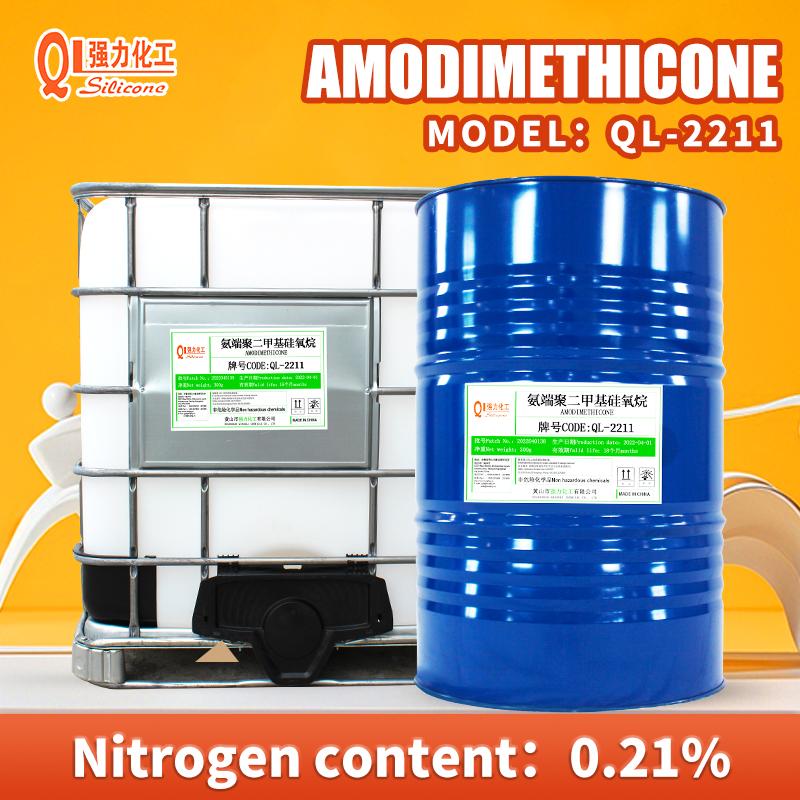
Aminosilicone Fabric Finishing Chemicals QL-2211
Price: Negotiable
Chinese Synonyms: Amino-modified polysiloxane; Amino silicone oil
English Name: Amino-modified silicone oil
Properties: Clear liquid
Applications:
1. When used in shampoo and hair care products, it makes hair softer, smoother, and shinier, significantly reduces combing resistance, and provides antistatic and wash-resistant properties.
2. When used to treat textile fibers such as cotton, wool, linen, and silk, it imparts a soft, smooth, and elastic feel to the fabric. Therefore, this product is an ideal ingredient for hair care cosmetics and fabric softening agents.
3. Used for polishing and protecting wooden and leather furniture, as well as flooring.
4. Other unlisted and potential applications.
Usage and Dosage
1. For use in shampoo and hair care products: First, emulsify the amino silicone oil into an emulsion using amphoteric or nonionic surfactants. Then, blend it into hair care products such as shampoos, conditioners, hair treatments, and mousses at a standard concentration of 0.5–1% by solid content. The amino silicone emulsion is a pre-emulsified silicone emulsion and can be added directly.
2. For softening and finishing of knitted and woven textiles such as cotton, wool, linen, and silk, the product must first be emulsified. The emulsified amino silicone emulsion is then added to the post-treatment wash solution and mixed thoroughly before use on the fabric. The dosage depends on the fabric being treated and technical requirements; generally, it is added at 0.3–1% (solid content) of the wash solution.
Currently, amino silicone oil is primarily used as a softening agent for textiles. Under normal circumstances and according to standard requirements, the selection of amino silicone oil for different fabrics is as follows:
① For pure cotton and blended knitted and woven fabrics, where a soft hand feel is the primary goal, amino silicone oil with an amine value of 0.6 is recommended;
② For pure polyester fabrics, where a smooth hand feel is the primary goal, amino silicone oil with an amine value of 0.3 is recommended;
③ For silk knitted and woven fabrics, where a smooth hand feel and high luster are required, amino silicone oil with an amine value of 0.3 is primarily selected, often blended with smoothing agents to enhance luster;
④ Wool and wool-blend fabrics: These require a combined feel of softness, smoothness, and elasticity with minimal color variation. Blended products containing amino silicone oils with 0.6 and 0.3 amine values can be selected; for some varieties, blending with a smoothing agent can enhance elasticity and luster;
⑤ Cashmere sweaters and fabrics: These have a higher overall feel than wool fabrics; high-concentration blended products can be selected;
⑥ Nylon hosiery: Primarily for a smooth hand feel; choose high-elasticity amino silicone oil;
⑦ Acrylic Raschel blankets, acrylic yarns, and blended yarns: Primarily for softness with high elasticity requirements; choose amino silicone oil with an amine value of 0.6 to meet elasticity needs;
⑧ Linen and ramie fabrics prioritize smoothness; primarily select amino silicone oil with an amine value of 0.3;
⑨ Rayon and viscose fabrics prioritize a soft hand feel; amino silicone oil with an amine value of 0.6 may be selected;
⑩ For low-alkali polyester fabrics, the primary goal is to enhance fabric hydrophilicity. Polyether-modified silicone oil (CGF) can be selected; this is produced through a silyl-hydrogen addition reaction between methyl-containing hydrogen silicone oil and polyethers such as polyethylene glycol or polypropylene glycol, which have unsaturated bonds at their termini. However, these oils have relatively poor softness. New polyether-modified silicone oils incorporate reactive epoxy groups into the siloxane chains, thereby improving the fabric’s hand feel and durability.
English Name: Amino-modified silicone oil
Properties: Clear liquid
Applications:
1. When used in shampoo and hair care products, it makes hair softer, smoother, and shinier, significantly reduces combing resistance, and provides antistatic and wash-resistant properties.
2. When used to treat textile fibers such as cotton, wool, linen, and silk, it imparts a soft, smooth, and elastic feel to the fabric. Therefore, this product is an ideal ingredient for hair care cosmetics and fabric softening agents.
3. Used for polishing and protecting wooden and leather furniture, as well as flooring.
4. Other unlisted and potential applications.
Usage and Dosage
1. For use in shampoo and hair care products: First, emulsify the amino silicone oil into an emulsion using amphoteric or nonionic surfactants. Then, blend it into hair care products such as shampoos, conditioners, hair treatments, and mousses at a standard concentration of 0.5–1% by solid content. The amino silicone emulsion is a pre-emulsified silicone emulsion and can be added directly.
2. For softening and finishing of knitted and woven textiles such as cotton, wool, linen, and silk, the product must first be emulsified. The emulsified amino silicone emulsion is then added to the post-treatment wash solution and mixed thoroughly before use on the fabric. The dosage depends on the fabric being treated and technical requirements; generally, it is added at 0.3–1% (solid content) of the wash solution.
Currently, amino silicone oil is primarily used as a softening agent for textiles. Under normal circumstances and according to standard requirements, the selection of amino silicone oil for different fabrics is as follows:
① For pure cotton and blended knitted and woven fabrics, where a soft hand feel is the primary goal, amino silicone oil with an amine value of 0.6 is recommended;
② For pure polyester fabrics, where a smooth hand feel is the primary goal, amino silicone oil with an amine value of 0.3 is recommended;
③ For silk knitted and woven fabrics, where a smooth hand feel and high luster are required, amino silicone oil with an amine value of 0.3 is primarily selected, often blended with smoothing agents to enhance luster;
④ Wool and wool-blend fabrics: These require a combined feel of softness, smoothness, and elasticity with minimal color variation. Blended products containing amino silicone oils with 0.6 and 0.3 amine values can be selected; for some varieties, blending with a smoothing agent can enhance elasticity and luster;
⑤ Cashmere sweaters and fabrics: These have a higher overall feel than wool fabrics; high-concentration blended products can be selected;
⑥ Nylon hosiery: Primarily for a smooth hand feel; choose high-elasticity amino silicone oil;
⑦ Acrylic Raschel blankets, acrylic yarns, and blended yarns: Primarily for softness with high elasticity requirements; choose amino silicone oil with an amine value of 0.6 to meet elasticity needs;
⑧ Linen and ramie fabrics prioritize smoothness; primarily select amino silicone oil with an amine value of 0.3;
⑨ Rayon and viscose fabrics prioritize a soft hand feel; amino silicone oil with an amine value of 0.6 may be selected;
⑩ For low-alkali polyester fabrics, the primary goal is to enhance fabric hydrophilicity. Polyether-modified silicone oil (CGF) can be selected; this is produced through a silyl-hydrogen addition reaction between methyl-containing hydrogen silicone oil and polyethers such as polyethylene glycol or polypropylene glycol, which have unsaturated bonds at their termini. However, these oils have relatively poor softness. New polyether-modified silicone oils incorporate reactive epoxy groups into the siloxane chains, thereby improving the fabric’s hand feel and durability.


CATEGORY
 Agriculture