

Address: Building 7, Xiaweishui Industrial Zone, Hongqiaotou Community, Yanluo Street, Bao'an District, Shenzhen
Country: China
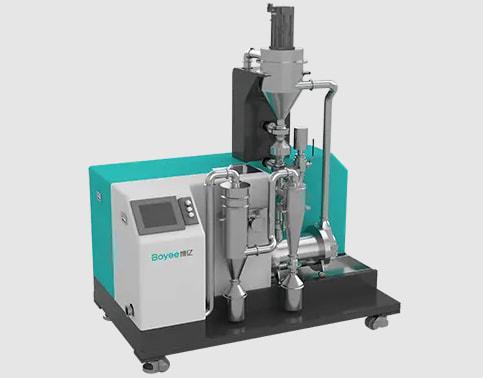
GFM-5L Dry Bead Mill
Price:
GFM-5L Dry Bead Mill
Principles of Mechanical Grinding
The ceramic rotor spins at high speed to drive the zirconia beads into motion. Through intense collisions between the zirconia beads and the material, large particles are broken down. Subsequently, the friction between the zirconia beads and the material, as well as between the material and the chamber, further re fines the material to the target particle size.
Principles of Precise Grading
The classi er utilizes speci fic airflow and mechanical structures to screen materials based on particle size and density differences, ensuring qualifi ed particles enter the collection stage and achieving precise particle size control.
Principle of Efficient Collection
The combination of a cyclone collector and dust collector is employed, where the cyclone collector recovers bulk material through centrifugal force, while the dust collector captures fine powder via filtration, achieving waste-free material recovery in Dry Bead Mill applications.
Equipment advantage
01 Dry Grinding Mill provides more uniform grinding force, ensuring stable fine grinding effect.
02 Real-time finess control, with an extremely narrow particle size distribution
03 Enhanced by fluidized bed technology achieving higher classification efficiency
04 Low-cost · Submicron · Zero-waste
05 Wear-resistant · Temperature-stable · Controllable
Integrated Grinding and Classification
More uniform grinding force stable fine grinding effect
The Nano Grinding or Nano Milling process utilizes a horizontal layout, enabling the grinding media to fully contact the material under the dual action of gravity and the stirring shaft.
Real-time finess control, with an extremely narrow particle size distribution
The classifier wheel operates synchronously with the grinding process. Based on centrifugal force, oversized particles are separated in real time and flung back into the grinding chamber for secondary grinding, while qualified particles pass through the classification gap into the collection system.
Enhanced by fluidized bed technology achieving higher classification effciency
Innovatively employing TSD classification technology, this system leverages fluidized bed air distribution to minimize pressure drop during the classification process, preventing material accumulation and blockage within the classification chamber.
Low-cost · Submicron · Zero-waste
Combining Affordability with Precision
Breaking through the high-energy consumption limitations of traditional air-jet mills, achieving low-cost mass production of submicron-level grinding
Zero-loss Design
Highly wear-resistant components + residue-free design.
Intelligent Control
Fully automatic adjustment of rotational speed, airflow and classifier parameters.
Wear-resistant · Temperature-stable · Controllable
Ceramic Pin-type Structure
Enhance the wear resistance of the rotor.
Silicon Carbide Cylinder
The outer layer circulates cooling water to control grinding temperature, ensuring the grinding temperature range.
Power Classifier
The particle size range of the material can be controlled.
Equipment advantage
01 Design for low viscosity, super fine grinding and decentralized
02 Use centrifugal force to realize the separation of grinding media
03 Dual -power design, make materials grinding and Separating independently
04 Design for low viscosity, super fine grinding and decentralized
05 Use centrifugal force to realize the separation of grinding media
06 Dual -power design, make materials grinding and Separating independently
For more information, please visit our website.
Principles of Mechanical Grinding
The ceramic rotor spins at high speed to drive the zirconia beads into motion. Through intense collisions between the zirconia beads and the material, large particles are broken down. Subsequently, the friction between the zirconia beads and the material, as well as between the material and the chamber, further re fines the material to the target particle size.
Principles of Precise Grading
The classi er utilizes speci fic airflow and mechanical structures to screen materials based on particle size and density differences, ensuring qualifi ed particles enter the collection stage and achieving precise particle size control.
Principle of Efficient Collection
The combination of a cyclone collector and dust collector is employed, where the cyclone collector recovers bulk material through centrifugal force, while the dust collector captures fine powder via filtration, achieving waste-free material recovery in Dry Bead Mill applications.
Equipment advantage
01 Dry Grinding Mill provides more uniform grinding force, ensuring stable fine grinding effect.
02 Real-time finess control, with an extremely narrow particle size distribution
03 Enhanced by fluidized bed technology achieving higher classification efficiency
04 Low-cost · Submicron · Zero-waste
05 Wear-resistant · Temperature-stable · Controllable
Integrated Grinding and Classification
More uniform grinding force stable fine grinding effect
The Nano Grinding or Nano Milling process utilizes a horizontal layout, enabling the grinding media to fully contact the material under the dual action of gravity and the stirring shaft.
Real-time finess control, with an extremely narrow particle size distribution
The classifier wheel operates synchronously with the grinding process. Based on centrifugal force, oversized particles are separated in real time and flung back into the grinding chamber for secondary grinding, while qualified particles pass through the classification gap into the collection system.
Enhanced by fluidized bed technology achieving higher classification effciency
Innovatively employing TSD classification technology, this system leverages fluidized bed air distribution to minimize pressure drop during the classification process, preventing material accumulation and blockage within the classification chamber.
Low-cost · Submicron · Zero-waste
Combining Affordability with Precision
Breaking through the high-energy consumption limitations of traditional air-jet mills, achieving low-cost mass production of submicron-level grinding
Zero-loss Design
Highly wear-resistant components + residue-free design.
Intelligent Control
Fully automatic adjustment of rotational speed, airflow and classifier parameters.
Wear-resistant · Temperature-stable · Controllable
Ceramic Pin-type Structure
Enhance the wear resistance of the rotor.
Silicon Carbide Cylinder
The outer layer circulates cooling water to control grinding temperature, ensuring the grinding temperature range.
Power Classifier
The particle size range of the material can be controlled.
Equipment advantage
01 Design for low viscosity, super fine grinding and decentralized
02 Use centrifugal force to realize the separation of grinding media
03 Dual -power design, make materials grinding and Separating independently
04 Design for low viscosity, super fine grinding and decentralized
05 Use centrifugal force to realize the separation of grinding media
06 Dual -power design, make materials grinding and Separating independently
For more information, please visit our website.


CATEGORY
 Agriculture